
Friuli Venezia Giulia is a marvellously complex region, rich in cultural nuances, diverse political, social and economic energies and tensions that converge into a collective identity and a unique territorial morphology. It is the result of a long and intense historical stratification, which was a pivotal point during two world conflicts. Friuli Venezia Giulia is made up of heterogeneous landscapes – the Adriatic, the Alps, the Karst, the Tagliamento River, and is an osmotic region where the borders with adjacent nations blur and vanish, sometimes becoming almost invisible. A region where architecture played a fundamental role during the 19th and 20th centuries, but which for decades has been undervalued is now being celebrated from new perspectives. Friulian modern architecture has often been seen as the “less brilliant sister” of Venetian architecture, overshadowed by the design prowess of the “Venetian School.” Moreover, in recent times, the lack of intervention in contemporary architecture, both small and large-scale, certainly hasn’t helped in enhancing the architectural history of this region, which is so complex and interesting at the same time, precisely because of its territorial and cultural osmosis with neighbouring countries. Left in the shadow, forgotten by critics and architectural history, many Friulian masters are now being rediscovered thanks to media operations and the use of this architecture as backdrops for editorials, videos, and photo shoots. Consider, for example, Marcello D’Olivo. A student of Giuseppe Samonà and Carlo Scarpa at the IUAV in Venice, D’Olivo pursued his career as an architect alongside his passion for painting and his love for studies in mathematics, physics, and statics. His architecture, such as the Spezzotti and Mainardis villas and the entire spiral master plan of Lignano Pineta, are inspired by sinusoidal forms derived precisely from his passion for both construction and exact sciences. An organicism where concave and convex forms, often present in his projects, descend from the abundance in the natural world as much as from mathematical sciences.

Check out Villa Spezzotti
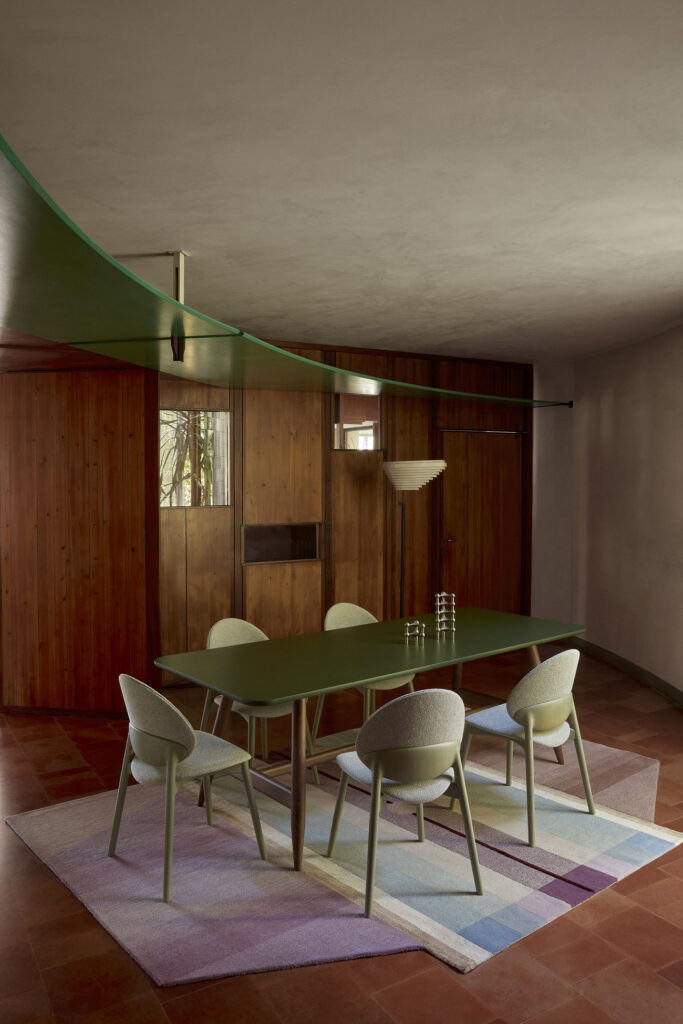
Check out Villa Scarpa
Even the works of great masters, such as Carlo Scarpa’s Villa Veritti in Udine, struggle to emerge in architecture books, giving precedence to his other famous projects like the Brion Tomb and the Olivetti shop.
A masterpiece completed in the late 1950s (1955-61), this single-family villa which embodies all the characteristic and recurring elements of Scarpa’s architecture: Venetian stucco, limewash treated plaster, hammered concrete, and his marvellous mahogany panelling. This may be a choice influenced by a critical bias, which may have been made over time, perhaps due to a geographical disadvantage, despite Udine being a city rich in great architects, all of whom, however, having passed through the IUAV, which in some way made them a “Venetian product,” like D’Olivo himself, Gino Valle, Gianni Avon, Angelo Masieri.
In recent times, many companies have chosen to highlight their products through a careful selection of the architecture that serves as the backdrop to their editorials, whether they be a design object or a clothing collection. Yet, Billiani seems to go further, as it does not only aim to work on the relationship between product and architecture in its shots, but also to build a narrative around the locations chosen as a backdrop. And this, for the company, is a way to tell the product’s story and provide a new, almost intimate, personal perspective: a tale of Friuli Venezia Giulia through the history of the product and its local area. A completely Friulian look, to shed light on these wonderful and forgotten places that deserve to be valued.
Bianca Felicori, a graduate of the Politecnico di Milano with a thesis in architectural history, is a researcher at UCLouvain. Since 2019, she has been managing the Forgotten Architecture project, which is a platform dedicated to forgotten architecture, which has also become a book by Nero Editions. The inspiration for this project includes the architecture of Marcello D’Olivo in Friuli Venezia Giulia, among others. biancafelicori